
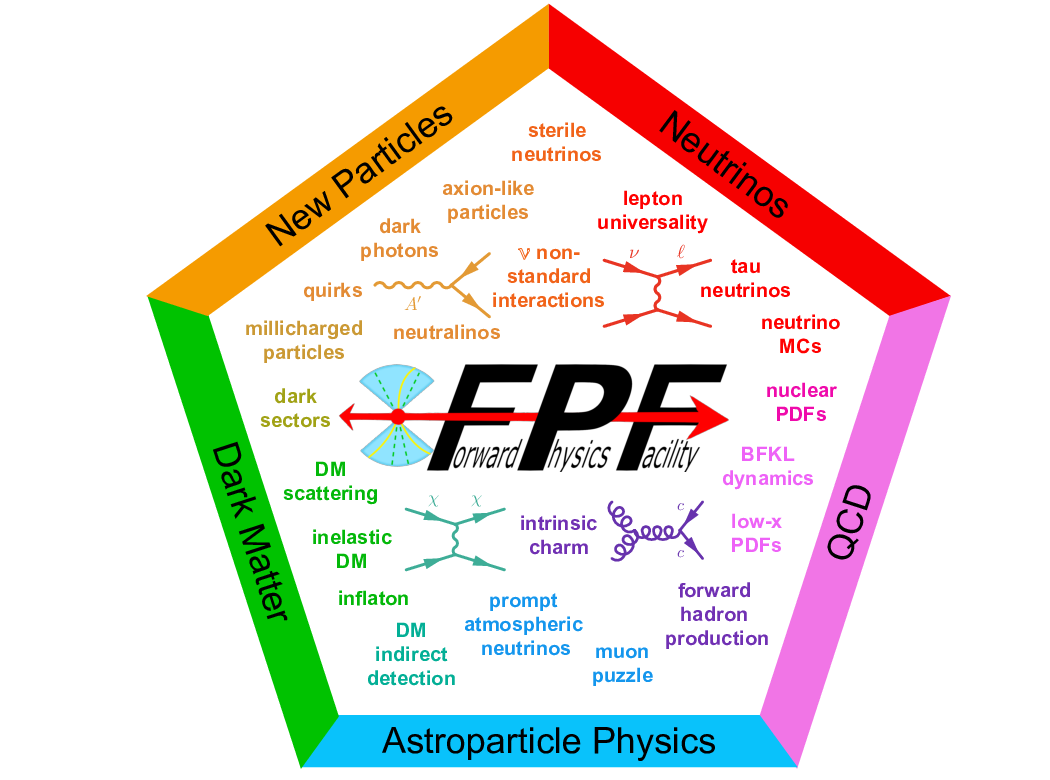
The Forward Physics Facility (FPF) is a proposal to build a new underground cavern at the Large Hadron Collider (LHC) to host a suite of far-forward experiments during the High-Luminosity LHC (HL-LHC) era. The existing large LHC detectors have un-instrumented regions along the beam line, and so miss the physics opportunities provided by the enormous flux of particles produced in the far-forward direction. Without the FPF, the HL-LHC will be blind to neutrinos and many proposed new particles. However, small pathfinder experiments currently operating in the far- forward region at the LHC have recently directly observed collider neutrinos for the first time and demonstrated the potential for world-leading sensitivity to new physics. With the FPF, a diverse suite of experiments will realize this potential by detecting ∼ 106 neutrino interactions at the highest energies from a human source, expanding our understanding of proton and nuclear structure and the strong interactions to new regimes, clarifying astroparticle data, and carrying out world-leading searches for light dark matter, dark sectors, and many other new particles. As shown in Fig. 1, the FPF physics program spans many frontiers and will greatly enhance the LHC’s physics program through to its conclusion in the 2040s.
The FPF is well aligned with the recommendations of recent community studies in the US and abroad:
Our highest immediate priority accelerator and project is the HL-LHC,…including the construction of auxiliary experiments that extend the reach of HL-LHC in kinematic regions uncovered by the detector upgrades. — Snowmass 2021 Energy Frontier Report
The full physics potential of the LHC and the HL- LHC…should be exploited. — 1st recommendation of the 2020 European Strategy Update
The FPF requires no modifications to the LHC and will support a sustainable experimental program, requiring no additional energy for the beam beyond the existing LHC program. In addition, as a mid-scale project composed of smaller experiments that can be realized on short and flexible timescales, the FPF will provide a multitude of scientific and leadership opportunities for junior researchers, who can make important contributions from construction to data analysis in a single graduate student lifetime.
About the Facility
-

FORMOSA
FORMOSA The FPF provides an ideal location for a next-generation experiment to search for BSM particles that have an electrical charge that is a small fraction of that of the electron. Although the value of this fraction can vary over several orders of magnitude, we generically refer to these new states as “millicharged” particles (mCPs).…
-
FLArE
FLArE A modularized liquid argon time projection detector (FLArE) is under development for the suite of detectors for the FPF. The technical design of such a detector is helped by the considerable investment in liquid noble gas detectors over the last decade (ICARUS, MicroBooNE, SBND, ProtoDUNE, and various components of DUNE). A liquid argon detector…
-
FASERv2
FASERv2 FASERν2 is a 20-ton neutrino detector located on the LOS, a much larger successor to the FASERν subdetector in the FASER experiment. An emulsion-based detector will identify heavy flavor particles produced in neutrino interactions, including tau leptons and charm and beauty particles. FASERν2 can perform precision tau neutrino measurements and heavy flavor physics studies,…