
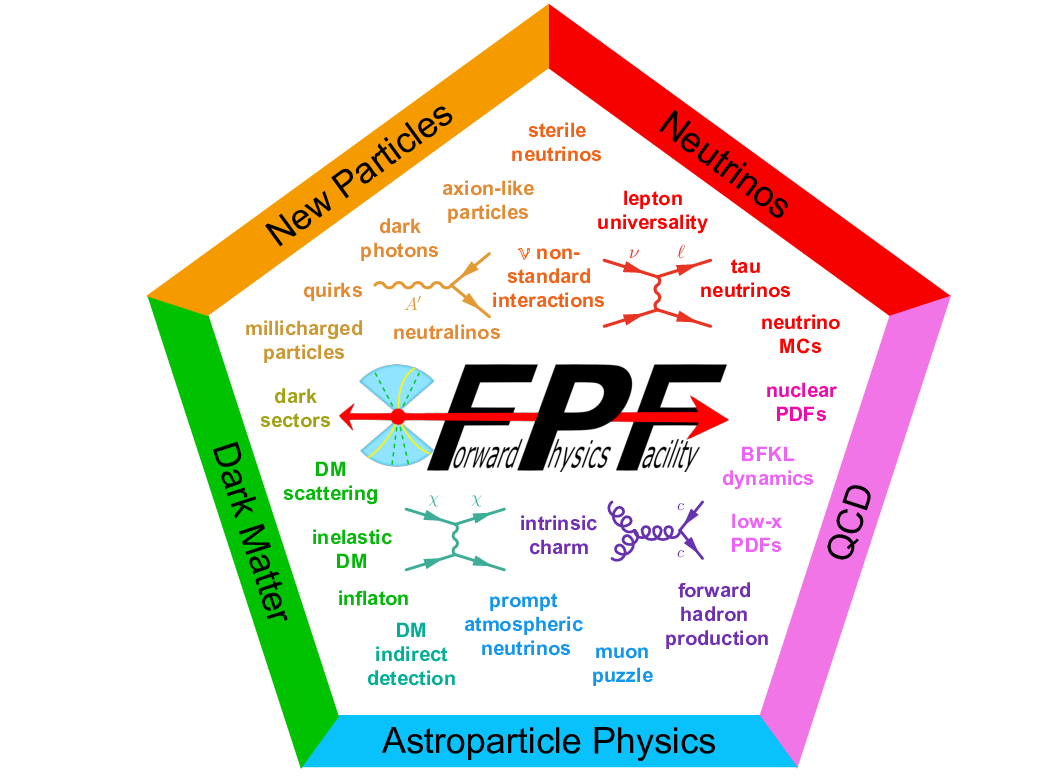
The science case for the FPF has been developed in five dedicated FPF meetings [7–11] and through numerous Snowmass meetings, primarily in the Energy, Neutrino Physics, Rare Processes and Precision, Cosmic, and Theory Frontiers [12]. The opportunities have been summarized in a 80-page review [13] and a more comprehensive 430-page Snowmass White Paper [14], written and endorsed by 400 physicists. Here we provide a brief summary of some of the physics topics, begin- ning with searches for physics beyond the Standard Model (BSM), and then moving to Standard Model (SM) topics.
Physics
-
FORMOSA
FORMOSA The FPF provides an ideal location for a next-generation experiment to search for BSM particles that have an electrical charge that is a small fraction of that of the electron. Although the value of this fraction can vary over several orders of magnitude, we generically refer to these new states as “millicharged” particles (mCPs).…
-
FLArE
FLArE A modularized liquid argon time projection detector (FLArE) is under development for the suite of detectors for the FPF. The technical design of such a detector is helped by the considerable investment in liquid noble gas detectors over the last decade (ICARUS, MicroBooNE, SBND, ProtoDUNE, and various components of DUNE). A liquid argon detector…
-
FASERv2
FASERv2 FASERν2 is a 20-ton neutrino detector located on the LOS, a much larger successor to the FASERν subdetector in the FASER experiment. An emulsion-based detector will identify heavy flavor particles produced in neutrino interactions, including tau leptons and charm and beauty particles. FASERν2 can perform precision tau neutrino measurements and heavy flavor physics studies,…